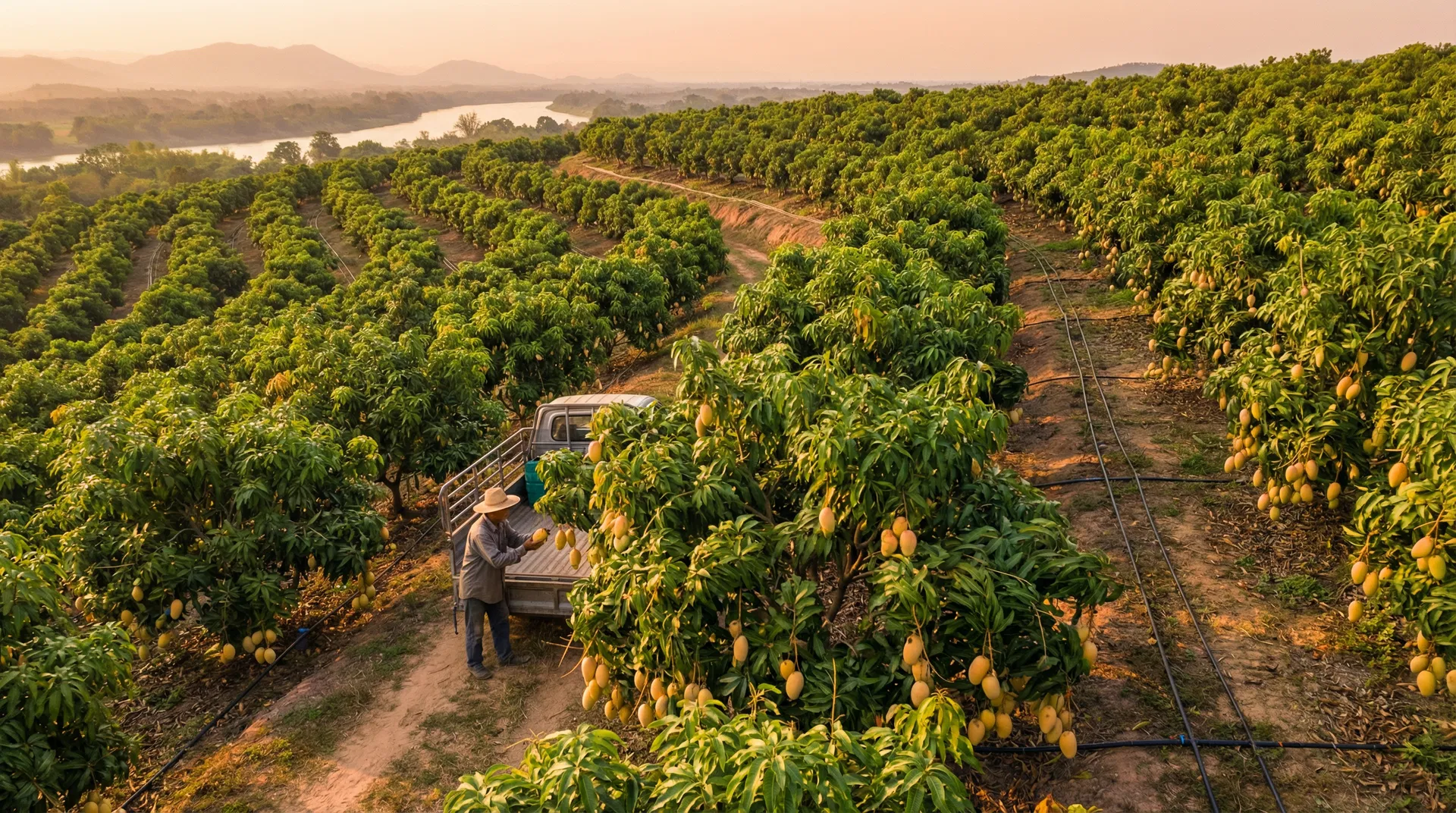
Mango (Mangifera indica) is one of the world's most commercially valuable tropical fruits, with global production exceeding 55 million tonnes annually. Yet many mango farmers consistently achieve only 60–70% of their potential yield due to suboptimal fertilizer programs. Choosing the right fertilizer — and applying it at the right time — is the single most impactful decision a mango grower can make. This guide explains exactly which fertilizers work best for mango, why liquid fertilizers outperform granular alternatives, and how a complete stage-specific program can increase your yield by 20% or more.
Nutrient Requirements of Mango Trees
Mango trees have complex, stage-specific nutritional needs that change dramatically throughout the annual growth cycle. Understanding these requirements is the foundation of any effective fertilizer program. The four primary macronutrients — nitrogen (N), phosphorus (P), potassium (K), and calcium (Ca) — each play distinct roles at different growth stages.
Nitrogen is essential during the vegetative flush stage, driving leaf and shoot development. However, excessive nitrogen during the flowering induction period suppresses flower bud formation — a common mistake that reduces fruit set. Phosphorus is critical during flowering, improving pollen viability and fruit set percentage. Phosphorus deficiency during this stage is one of the leading causes of poor fruit set in commercial mango orchards.
Potassium is the most important nutrient for fruit quality. It drives sugar accumulation, improves fruit color, increases firmness, and extends shelf life. High-K programs during the fruit swelling and pre-harvest stages consistently improve Brix levels by 2–3 degrees in field trials. Calcium prevents fruit cracking, tip burn, and internal breakdown — defects that cause significant export rejection losses.
Beyond macronutrients, mango trees require a range of micronutrients including boron (B), zinc (Zn), iron (Fe), and manganese (Mn). Boron deficiency is particularly damaging — even mild deficiency reduces fruit set by 20–30% by impairing pollen germination. Zinc deficiency causes "little leaf" syndrome and poor shoot development. A complete liquid fertilizer program must address all of these nutritional needs with precise timing.
Key Insight: Mango trees in field trials using drip-applied liquid fertilizers showed 35% higher yield and 2.5° Brix improvement compared to equivalent granular programs over two seasons.
Best Fertilizer Types for Mango
Not all fertilizers are equally effective for mango production. The three most impactful fertilizer types — organic fertilizer, seaweed fertilizer, and NPK liquid fertilizer — each contribute uniquely to mango yield and quality when used as part of an integrated program.
Organic Fertilizer
Organic fertilizers (including composted manure, fish hydrolysate, and amino acid fertilizers) improve soil biology, increase organic matter content, and provide a slow-release source of nitrogen and trace minerals. They are particularly valuable for improving soil structure in heavy clay soils common in tropical mango regions. Organic fertilizers work best as a base program, applied 2–3 times per year to build long-term soil health.
Seaweed Liquid Fertilizer
Seaweed extract is one of the most powerful biostimulants available for mango production. It contains natural cytokinins, auxins, and alginic acid that stimulate root development, improve flowering uniformity, and reduce fruit drop. Applied as a foliar spray during the flowering and fruit set stages, seaweed fertilizer consistently reduces mango fruit drop by 40–60%. It also improves drought tolerance — critical for mango orchards in water-stressed environments.
NPK Liquid Fertilizer
Stage-specific NPK liquid fertilizers deliver precisely balanced macronutrients at each growth stage. High-P formulas (10-30-10) during flowering induction, balanced formulas (15-15-15) during fruit development, and high-K formulas (12-6-40) during pre-harvest ripening — each targeting the specific nutritional demand of that growth phase. Applied via drip irrigation, NPK liquid fertilizers achieve 85–90% nutrient use efficiency compared to 40–50% for granular alternatives.
Why Seaweed Fertilizer Is Essential for Mango
Among all fertilizer types, seaweed liquid fertilizer has the most dramatic impact on mango fruit set and retention — the two factors that most directly determine final yield. Here's why seaweed fertilizer is indispensable in any mango nutrition program:
For a complete overview of seaweed fertilizer benefits across all crops, see our Seaweed Liquid Fertilizer product page.
Complete Mango Liquid Fertilizer Program
The following stage-specific program is based on field trials conducted across Southeast Asia, South Asia, and Latin America. Adjust rates based on soil test results, tree age, and variety. All products are 100% water-soluble and compatible with drip irrigation systems.
| Growth Stage | Product | Function | Rate |
|---|---|---|---|
| Seedling / Transplant | Root Stimulant + Humic Acid | Promote root development | 3 L/ha |
| Vegetative Flush | Balanced NPK (15-15-15) | Drive shoot and leaf growth | 5 L/ha |
| Flowering Induction | High-P NPK (10-30-10) | Improve flowering rate | 5 L/ha |
| Fruit Set (0–4 wks) | Seaweed Fertilizer + Ca-B | Reduce fruit drop | 4 L/ha |
| Fruit Growth | Balanced NPK + Seaweed | Increase fruit size | 6–8 L/ha |
| Pre-Harvest | High-K NPK (12-6-40) | Increase sweetness & color | 3 L/ha |
Application Method and Dilution Rates
Liquid fertilizers for mango can be applied via two primary methods: drip irrigation (fertigation) and foliar spray. Each method has specific advantages depending on the growth stage and target nutrient.
Foliar Spray
Dilution ratio: 1:500–800
Every 10–15 days
Flowering, fruit set, micronutrient correction. Apply in early morning or late afternoon to avoid leaf burn. Nutrients are absorbed within 2–4 hours.
Drip Irrigation (Fertigation)
Dilution ratio: 1:200–400
Weekly during active growth
NPK and humic acid applications throughout the season. Delivers nutrients directly to the root zone with 85–90% uptake efficiency.
Results and Benefits of a Complete Mango Fertilizer Program
Mango farmers who implement a complete liquid fertilizer program — combining organic fertilizer, seaweed extract, and stage-specific NPK — consistently report the following results across field trials in Vietnam, Thailand, India, and the Philippines:
Beyond yield numbers, a complete liquid fertilizer program improves fruit size and uniformity, enhances sweetness and color for premium market positioning, increases resistance to environmental stress (drought, heat, disease), and reduces overall input costs through higher nutrient use efficiency.
For the full mango fertilizer program with stage-by-stage application schedules, visit our Fertilizer for Mango Solution page. To explore individual product specifications, packaging options, and OEM pricing, see our Seaweed Fertilizer, Humic Acid Fertilizer, and NPK Liquid Fertilizer product pages.
Conclusion: A Combination of Fertilizers Delivers the Best Results
There is no single "best fertilizer for mango" — the highest yields come from a combination of fertilizer types, each applied at the right growth stage. Organic fertilizer builds long-term soil health. Seaweed fertilizer protects flowering and fruit set. NPK liquid fertilizer delivers stage-specific macronutrients for growth, development, and quality. Together, these three pillars form a complete mango nutrition system that consistently outperforms any single-product approach.
The key is consistency and timing. Apply the right product at the right stage, use liquid fertilizers via drip irrigation or foliar spray for maximum uptake efficiency, and monitor your trees' response to fine-tune the program for your specific variety, soil, and climate. With a well-designed liquid fertilizer program, a 20–35% yield increase is achievable within the first two seasons.
Learn More About Our Mango Solution
Get a customized fertilizer plan designed for your mango variety, soil type, and target market.